Ion Exchange: Selecting the Right Resin for Targeted Water Treatment Outcomes
April 16, 2026
Ion exchange is a well-established and highly adaptable technology used in industrial process and wastewater treatment and a variety of municipal water treatment applications. Its effectiveness lies in the ability to tailor resin selection and system design to suit specific contaminants, whether that be PFAS, hardness (alkalinity), or dissolved metals. While the underlying principle remains consistent, the choice of resin and configuration can vary significantly depending on the treatment objective.
Types of Ion Exchange Resins
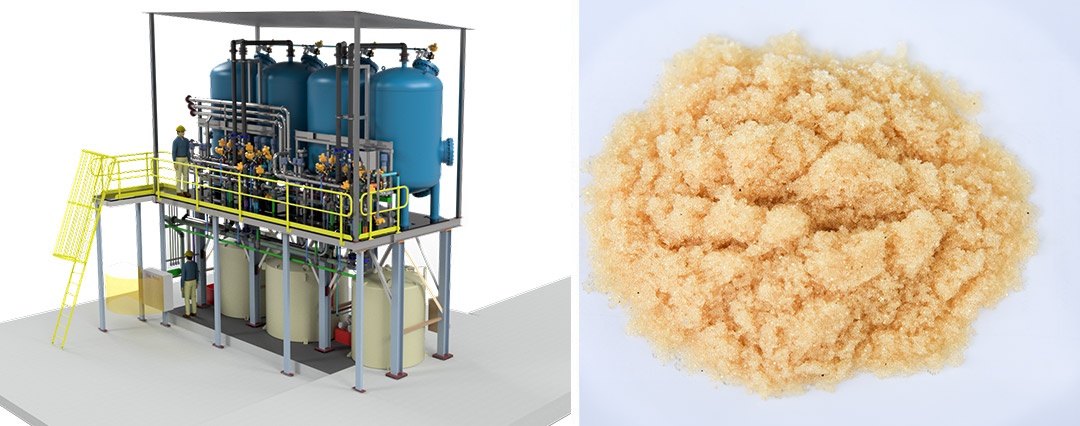
Ion exchange resins are broadly categorised into cation and anion types, with further distinction between strong and weak functional groups:
Strong Acid Cation (SAC) Resins
Commonly used for hardness removal and dissolved metal polishing, SAC resins exchange cations (positively charged species, e.g. metals) with hydrogen ions. They are robust and operate effectively across a wide pH range. SAC resins are often paired with WAC resins to optimise overall operating costs.
Weak Acid Cation (WAC) Resins
Typically applied for hardness reduction and dealkalisation, WAC resins are more selective than SAC resins, targeting cations associated with alkalinity (e.g. Ca²⁺ and Mg²⁺). While less comprehensive than SAC, they consume significantly less chemical during regeneration, making them a cost-effective option for process water polishing where hardness removal is the primary objective.
Strong Base Anion (SBA) Resins
Used for removal of anions (negatively charged ions) such as nitrate, sulphate, silica and increasingly PFAS. These resins are available in different types (Type I and Type II), with varying affinities and regeneration characteristics.
Weak Base Anion (WBA) Resins
Suitable for removal of strong acids and organic matter. Similar to WAC, often used upstream of SBA resins to reduce chemical consumption and improve overall system efficiency.
Hydroflux has a comprehensive range of resins available in the HyX series.
The Role of Testing and Validation
Given the variability in water chemistry and contaminant profiles, resin selection should not be based on assumptions alone.
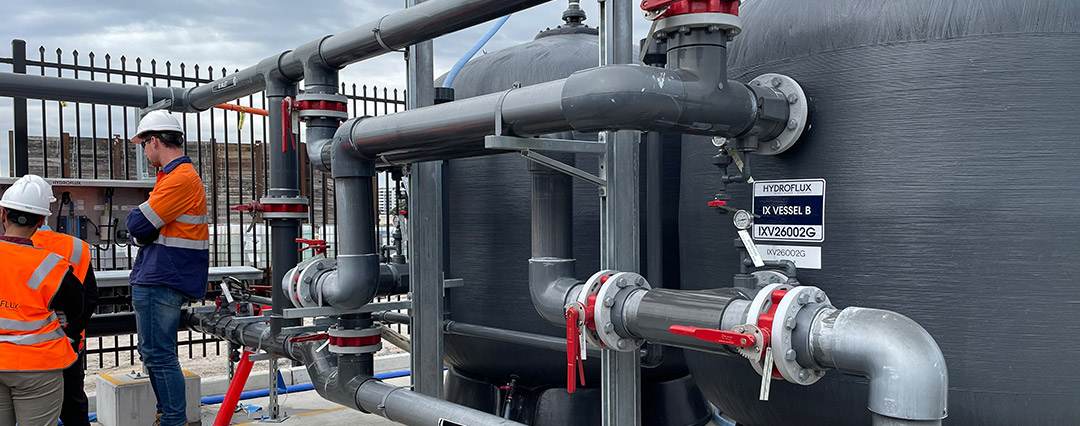
Hydroflux has the capability to undertake bench-scale ion exchange testing, for complex water matrices, such as groundwater containment with PFAS or leachate. Bench-scale testing allows different resin types and configurations to be evaluated under site-specific conditions by in-house experts which is an ideal approach as it provides confidence in predicted performance, resin life, and operating costs, and ensures that full-scale systems are designed with a high degree of certainty.
System Designed to Maximise Resin Life
While certain resins can be regenerated using chemicals (e.g. brine, acid, or caustic), ion exchange resins are ultimately consumables and will require replacement after a prolonged period of operation. If not properly designed, resin replacement can represent a significant portion of the operating cost of an ion exchange system.
Hydroflux systems are designed with whole-of-life cost in mind, aiming to minimise resin replacement frequency, and often includes the incorporation of resin regeneration systems to extend resin life.
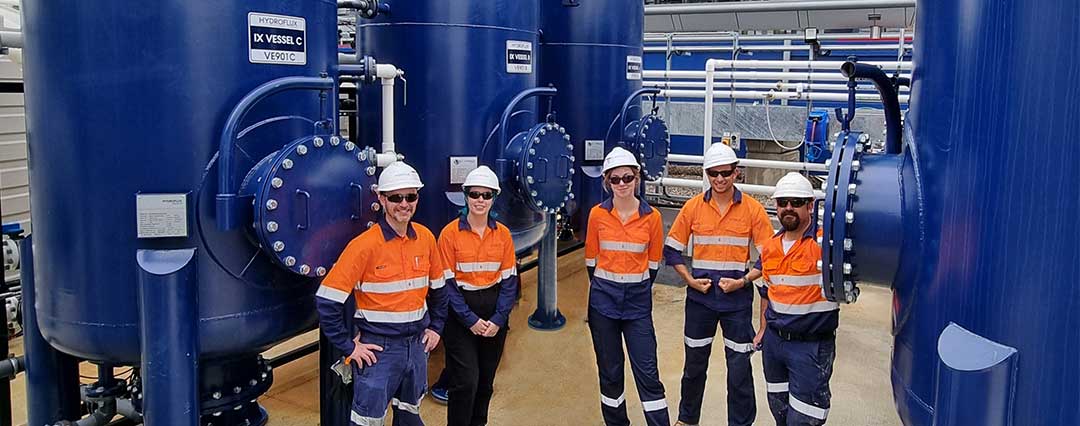
Hydroflux has delivered filtration and ion exchange systems across a wide range of industries and applications. This experience, combined with in-house process and engineering capability, enables systems to be configured to suit specific operating requirements — from food-grade process water with heat-sanitisation constraints to temporary construction installations managing complex wastewater streams in demanding environments. Systems are designed to be practical, robust and aligned with the realities of operation, rather than theoretical design assumptions.
To learn about our industrial water and wastewater treatment solutions please contact us on 09 352 2052 or visit www.hydrofluxindustrial.nz.
About the Hydroflux Group
The Hydroflux Group aims to deliver the highest level of engineering and scientific know-how to the emerging issues of sustainability, climate adaptation and environmental protection with a specific focus on water and wastewater.
As part of its vision and mission, Hydroflux has always taken its climate responsibility seriously. In 2022, Hydroflux became Australia’s first water treatment and technology company to achieve Climate Active carbon neutral certification for its organisation and products. It knows that partnering with customers and clients is the most significant impact it can have in its journey. The Group employs over 100 staff and operates throughout Australia, New Zealand and the Pacific Islands, with office locations in Sydney, Melbourne, Brisbane, Adelaide, Perth, Auckland, and Suva.